


Beyond Spectacle: What the 2025 Biennale Really Teaches About Intelligence in Architecture
Written by Charles Fang @MBA architects
The 19th edition of the International Architecture Exhibition, which ran from 10 May to Sunday 23 November 2025 (pre-opening on 8 and 9 May), has also come to an end.
We visited this exciting 2025 Venice Biennale in November alongside American, Italian, and English colleagues from the American Institute of Architects (AIA). The exposition unfolded as one of the most technologically charged and environmentally anxious editions yet. Curated by Carlo Ratti, the 19th Biennale took the title “Intelligens. Natural. Artificial. Collective.” and cast architecture as a field caught between planetary crisis and the seductions of computation. Across the Giardini, Arsenale, and the city’s scattered collateral events, visitors moved through a dense landscape of robots mixing Aperol spritz, AI-generated floor plans, microbial bricks, and bio-based materials, all vying to prove that architecture can be as “smart as a tree.”*


Within this sprawling field, MBA Architect's principal, Matteo Borsetti, highlights a handful of projects that crystallized the Biennale’s tensions and possibilities, especially in the Arsenale: SO–IL and Mariana Popescu’s Necto, the Norman Foster Foundation and Porsche’s Gateway to Venice’s Waterway, and Lina Ghotmeh’s “10,000 Hours of Care,” presenting her Precise Acts – Hermès Workshops. Together, they framed the Biennale’s central questions: can advanced technology genuinely serve circularity and care, or does it simply polish familiar spectacles?
Theme and atmosphere: between lab and funfair
Ratti’s curatorial concept splits “intelligence” into three strands—natural, artificial, and collective—using the Biennale as a testbed for how these forms of thinking might co-evolve. The result is the largest edition to date, with more than 280 projects and some 750 participants, much of it selected through an open call.*
Critics noted that this generosity of inclusion came at a cost. Reviewers compared the Arsenale’s central show to a chaotic science fair: galleries overflowing with prototypes, sensors, speculative diagrams, and earnest wall texts about climate, data, and resilience.* Yet if the Biennale sometimes felt overstuffed, that density also made the standout works feel sharper; especially those that didn’t just explain intelligence but embodied it spatially and materially.

Three projects did that particularly well, each staging a different relationship between structure, technology, and care.
1) Necto: intelligence as tensioned fabric
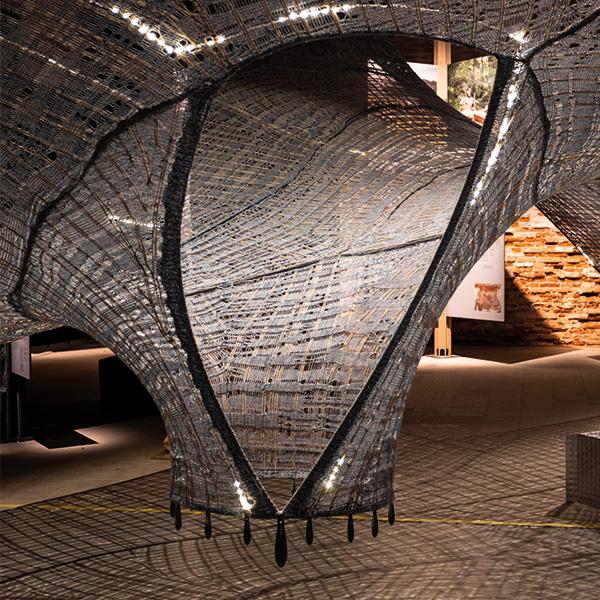
One of the first genuinely memorable encounters in the Arsenale is Necto, by SO–IL, structural engineer Mariana Popescu, and design research practice TheGreenEyl. Suspended in the “Natural Intelligence” section of the central exhibition, Necto is a flowing anticlastic surface; a continuous, saddle-like textile canopy that dips, twists, and funnels through the long brick nave of the Corderie.
This gallery captures NECTO a flowing, woven architectural installation that forms organic, textile-like spaces of light and shadow. Its suspended mesh surfaces create immersive, sculptural paths that visitors can walk through and experience up close. © 2025 Mba Photography
The project operates at three scales at once:
Spatial choreography
The knitted surface is tuned into three distinct architectural moments: an enveloping cone you can walk beneath, a slender column-like element that seems to grow from the floor, and a hanging mass that hovers above head height. These elements create pockets of compression and release, and the play of shadows on the cobbled floor turns the entire room into a kind of woven landscape.
Material experiment
Necto is fabricated from 3D-knitted natural fibre strips, joined into a continuous web. The textile is selectively coated with a bio-based stiffening agent, so some zones remain supple while others become almost shell-like. This gradation in stiffness lets the structure toggle between tensile membrane and quasi-solid surface.
Lifecycle intelligence
The installation is explicitly designed for disassembly, transport, and reuse: about 100 m² of knitted textile, in 12 pieces, weighing just 38.5 kg, 95% of it biodegradable, shipped in compact packages and erected without heavy machinery. After the Biennale, Necto can be re-knitted into new forms or reassembled elsewhere, making the structure as much a material protocol as an object.
Conceptually, Necto addresses the Biennale’s “Intelligens” theme by proposing that intelligence can be embedded in fabrication logic and material behavior, not only in algorithms and screens. Popescu’s long-running research into knitted formwork for concrete—developing lightweight, reusable moulds that replace conventional timber and steel—is folded into the installation. Reviewers have highlighted how this approach could drastically reduce the waste associated with one-off casting, by replacing heavy, discarded formwork with textiles that can be reconfigured over multiple pours.
In the context of an exhibition heavy on visualizations of future systems, Necto feels unusually resolved yet open-ended: a real structure that you can inhabit today, but also a prototype for an entire family of low-impact, high-complexity construction methods.
2) Gateway to Venice’s Waterway: spectacle, mobility, and corporate dreams
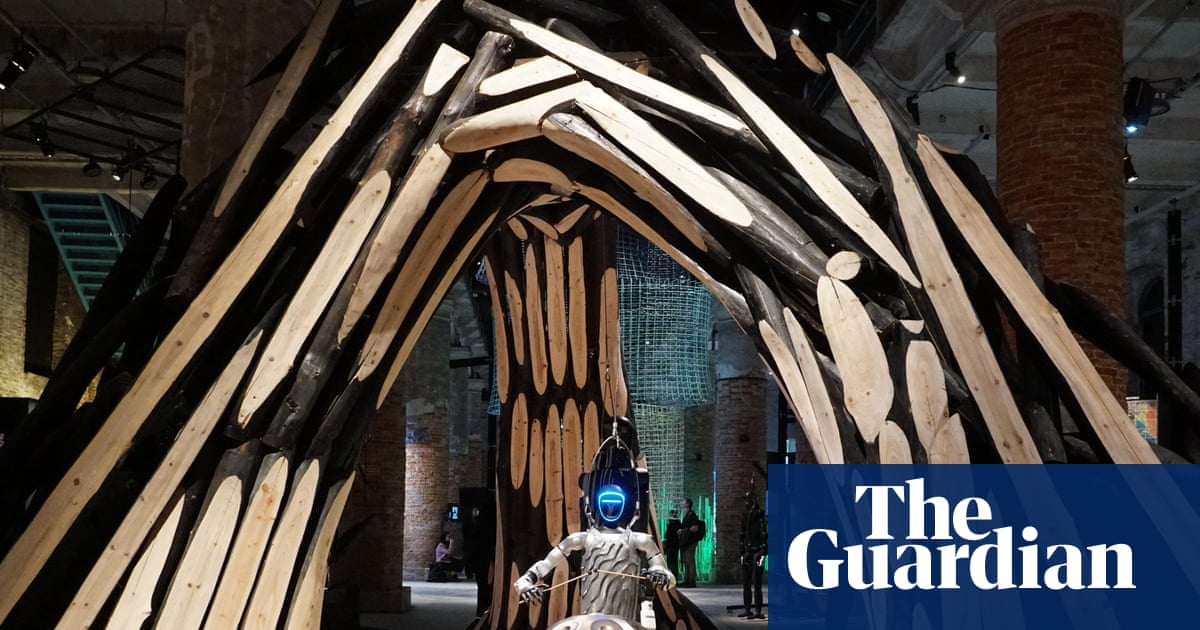
At the Arsenale’s waterfront, the tone shifts from soft textiles to shimmering metal. Here, the Norman Foster Foundation, in collaboration with Porsche, presents Gateway to Venice’s Waterway, a 37–45-meter-long bridge-like structure that stretches from the quay out over the water.
This gallery shows the Gateway to Venice’s Waterway , blending reflective metal geometry with fluid, tunnel-like forms. Its lightweight structure creates a dynamic passageway that captures light, movement, and the surrounding lagoon.
The installation belongs to Porsche’s “Art of Dreams” series and is framed as a visionary transport hub for a future Venice, combining:
A tubular ramp that acts as a covered pier, its skin clad in kinetic aluminium “scales” that open and close like a mechanical fish or dragon, modulating shade, wind, and views.
A floating platform for electric boats and water bikes, tapping into Foster’s long-standing interest in cleaner, quieter urban mobility over water.
Formally, the bridge riffs on both Venice’s historic infrastructure and Porsche’s lightweight race-car engineering, with triangulated aluminium members and a taut, parametric geometry. It almost reads as a full-scale mock-up of an infrastructural product line; something that could be repeated around the lagoon.
Critics have been divided. Some design press celebrate it as a star of the Biennale, pointing to its ambitious attempt to translate high-performance automotive thinking into public mobility infrastructure and to its alignment with electric propulsion. Others see in it a nostalgic echo of early-2000s parametric spectacle, “a big tubular ramp… wrapped with a billowing skin of metal scales” that could have been built 20 years ago, despite being pitched as a vehicle for future mobility.
Yet the piece does stage an important question for this Biennale: what role do corporate actors play in the re-imagining of cities under climate stress? Gateway to Venice’s Waterway is both a design proposal and a branding exercise. It operates in the ambiguous space where sponsorship, research, and urban prototype blur—a dynamic that runs through many large-scale commissions in Venice this year.
If Necto uses advanced techniques to dematerialize structure and emphasize circularity, Foster and Porsche lean into durability, recognizability, and infrastructural permanence. The bridge is a dream of a future Venice in which high-end technology does not retreat but becomes the armature of a new, “cleaner” everyday mobility.
3) 10,000 Hours of Care: craftsmanship as collective intelligence
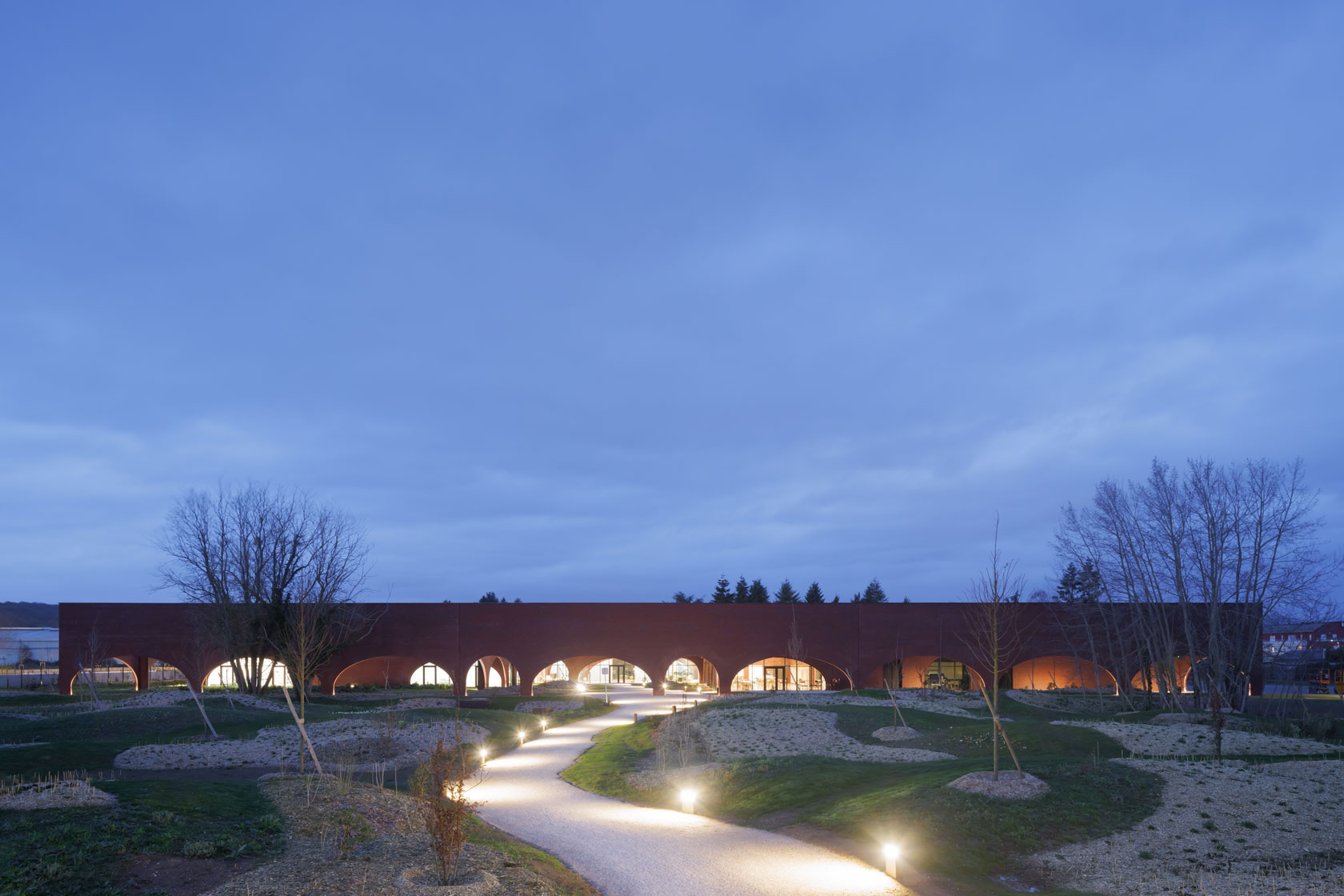
In the Collective Intelligence strand of the Biennale, Lina Ghotmeh – Architecture presents “10,000 Hours of Care,” a quietly powerful installation that re-frames her Hermès leather workshops in Louviers, Normandy—the project titled Precise Acts – Hermès Workshops—as an architecture of care, labor, and low-carbon construction.
The workshops themselves, completed in 2023, are celebrated as France’s first passive, energy-positive, low-carbon industrial building, built almost literally out of its context: about 500,000 bricks of local clay, with masons retrained to work at that scale of handmade production.
At Venice, Ghotmeh translates this built work into an exhibition that insists on time and skill as forms of intelligence:
The title “10,000 Hours of Care” riffs on Malcolm Gladwell’s popularization of the 10,000-hour rule, here applied to the 500,000 hours of artisanal labor that went into crafting the Louviers façade.
Models, drawings, and film sequences walk visitors through the brick arches, deep windows, and daylight strategies that let the workshops function as a humane, climate-conscious factory—less a “shed” than a landscape of vaulted halls embedded in the Norman soil.
This gallery show the model of Hermès Workshops and highlights earth-based architecture shaped by craftsmanship and landscape, where grids, materials, and forms emerge naturally from the ground. It reflects a precise, sustainable, and poetic dialogue between structure, terrain, and human hands. © 2025 Mba Photography
Where Necto and the Gateway operate primarily through formal and structural innovation, Ghotmeh foregrounds process: training, collaboration, and the re-activation of local material cultures. The Hermès building is designed as a manifesto of collective intelligence between humans, materials, and landscape, a theme echoed in recent descriptions of the project as a “manifesto of collective intelligence—of humans, materials, and nature working in symbiosis.”
In the context of Ratti’s theme, Ghotmeh’s contribution argues that careful, situated making is itself a form of “Intelligens”. Artificial intelligence appears here not as a central protagonist but as one player among many; the real emphasis is on embodied knowledge, regional resources, and long-duration commitment.
Reading the Biennale through these three works
Taken together, Necto, Gateway to Venice’s Waterway, and 10,000 Hours of Care / Precise Acts trace three distinct but overlapping trajectories through the 2025 Biennale:
Material and structural intelligence (Necto)
Uses computation and advanced fabrication to radically reduce material and enable disassembly.
Embeds intelligence in behavior and lifecycle, offering a template for reversible, lightweight construction that could transform temporary works and even concrete formwork.
Infrastructural and corporate intelligence (Gateway)
Stages a speculative piece of mobility infrastructure, linking a global brand to the future of a fragile city.
Raises unresolved questions about who funds and authors visions of urban resilience, and whether such visions are truly adaptive or primarily symbolic.
Collective and territorial intelligence (Ghotmeh / Hermès)
Shows how craft, training, and local materials can deliver a factory that is both low-carbon and spatially generous.
Recasts industrial architecture as a site of slow, cumulative care rather than pure efficiency.


Against the backdrop of a Biennale sometimes criticized for being an “overwhelming” array of tech demos and speculative scenarios, these three projects stand out because they link lofty themes to concrete architectural decisions: what to make, with whom, from which materials, and with what afterlife.
They also expose the Biennale’s core ambivalence. On one hand, the show is full of experiment, radical in its embrace of AI, living materials, and new forms of practice. On the other, some of its most visible commissions lean on familiar tropes—glimmering bridges, large-scale sponsorships, and photogenic installations that echo earlier cycles of digital optimism.
If there is a takeaway from Venice Biennale 2025, it might be this: intelligence in architecture is no longer about simply being “smart” or “high-tech.” It is about how different kinds of intelligence (natural, artificial, and collective) are negotiated in specific projects. Sometimes that negotiation produces a lightweight knitted canopy you can pack into two suitcases. Sometimes it yields a kinetic bridge sponsored by a sports-car brand. Sometimes it looks like half a million bricks, hand-laid in a Norman field.
The Biennale doesn’t resolve these tensions. But in its most compelling works ( like those by SO–IL & Popescu, Norman Foster & Porsche, and Lina Ghotmeh) it makes them tangible enough to walk under, walk across, and critically inhabit.
Sources:
*
1)


2)
3)

Credit Images: © 2025 Mba Photography


Comments